A few years ago I became severely ill. Despite being in the best shape of my adult life, I found myself laid out. In pain. Unable to eat properly. Rapidly losing weight. Unable to sleep for more than an hour or two at a time. I couldn’t physically leave my apartment so, whenever I could manage, I picked up books on rock climbing and mountaineering.
I read an angsty classic by Mark Twight, essays by Jon Krakauer (among my favorites is an anecdote about the corrosive boredom of being stuck in a tent on mountain with a friend in a snowstorm), and a modern history of sport climbing titled Hangdog Days, among others. Arno Ilgner’s book, in particular, has helped me think about the mindset I bring not only to routes but to other life stresses.
For context: while reasonably safe, lead climbing requires substantially more mental control than top-roping or (non-high ball) bouldering. Anyone can act like a hero on top rope. When you’re well above your last bolt or piece of protection, however, that heroism is tested. If you botch it… you’re going for a ride. And there are number places where I climb in the mid-Atlantic, particularly on easier routes, where one simply must not take a lead fall.
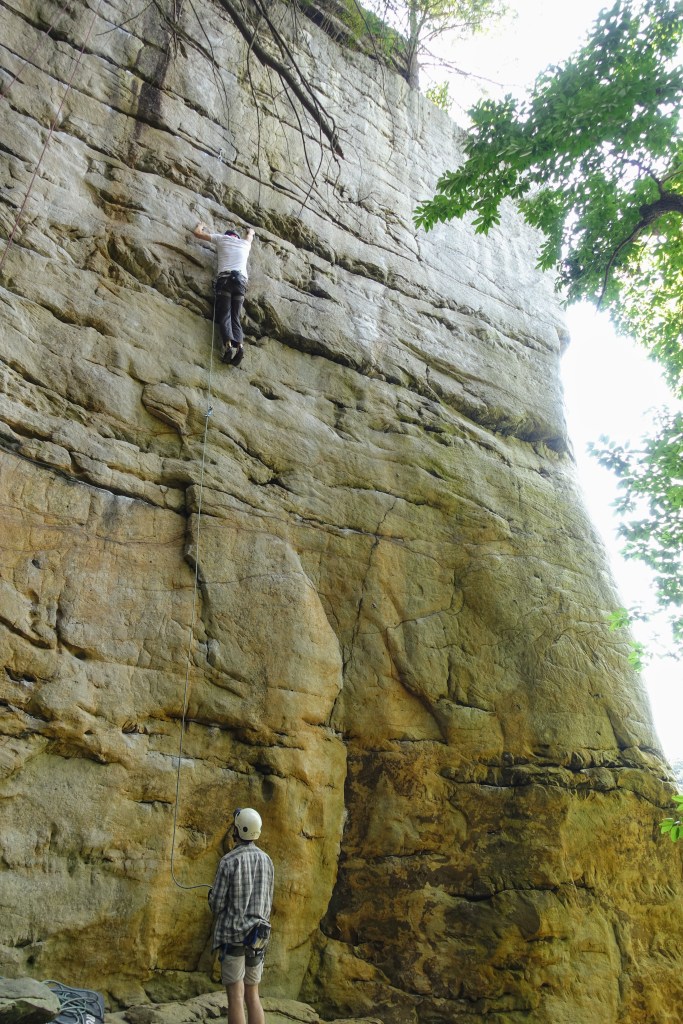
Most, intuitively, understand the difference between objective and subjective risk when it comes to falling. It’s the difference between smacking a ledge, for instance, and taking a heart-in-throat 10 meter whip into open air. The latter, while intimidating, is perfectly safe. In practice, the distinction isn’t always so clear. It can be difficult to sort one form of risk from the other. It’s a learned skill.
Errors in judgement can be significant. Not understanding objective threats, of course, can be devastating. With climbing, misperception is a literal threat to life and limb. You can’t manage what you don’t understand. Likewise, confusing subjective risks with objective ones has a cost. A failure to appreciate that a situation can be scary, but relatively safe, inhibits personal growth and closes off opportunity.
We all try to tune our risk tolerance. At the crag, for example, my appetite is relatively low; I prefer the puzzle-solving and gymnastic challenge of climbing, not the rush of mastering mind and body in the face of severe injury or death. We all do something similar across the various domains of our life. Some are directly analogous to the physical risks of climbing (say how we drive on the highway) and others go beyond physical injury to other harms (how we invest and spend money for instance). Moreover, we may be risk seeking in one domain and risk averse in other.

That all sounds reasonable in principle, but managing the feeling of risk is a distinct and difficult task — even when one believes the objective risk to be acceptable. Responding to fear has to be trained. And it’s here that I’ve found Ilgner’s advice helpful. Among the useful gems he offers is the following on ‘soft eyes’:
Instead of allowing your face to grimace, deliberately keep the face relaxed with a “soft-eyes” focus. Eyes should be comfortably open, held softly, not squinting or staring. Your attention should be on the whole field of view rather than on specific points in that field. Don’t focus on your hands, your feet, or one portion of the rock. Rather, spread out attention and look at color, depth, shadows, and the interrelationships between objects.
The physical responses that narrow our perception can be trained. Squinting eyes. A racing heart. Once understood, it becomes possible try hard. To allocate effort efficiently. To use the full force of our reason, our experience, to respond to the next moves in front of us. I’ve found more generally that situations that provoke fear and anxiety benefit from an awareness of my physical response to that stress. A similar approach has paid dividends in other environments in my life with some success: workplace social pressures, arguments with loved ones, and so on. Soft-eyes, for me, is a simple but helpful cue.
 Swolitical science
Leave a comment